
Most small business owners meet master keying at the worst possible moment: somebody quit, nobody knows which keys they had, and the building turns out to have four generations of locksmith decisions layered on top of each other.
Here is what a master key system is, in plain terms, and what separates one that lasts from one that quietly falls apart.
The basic idea
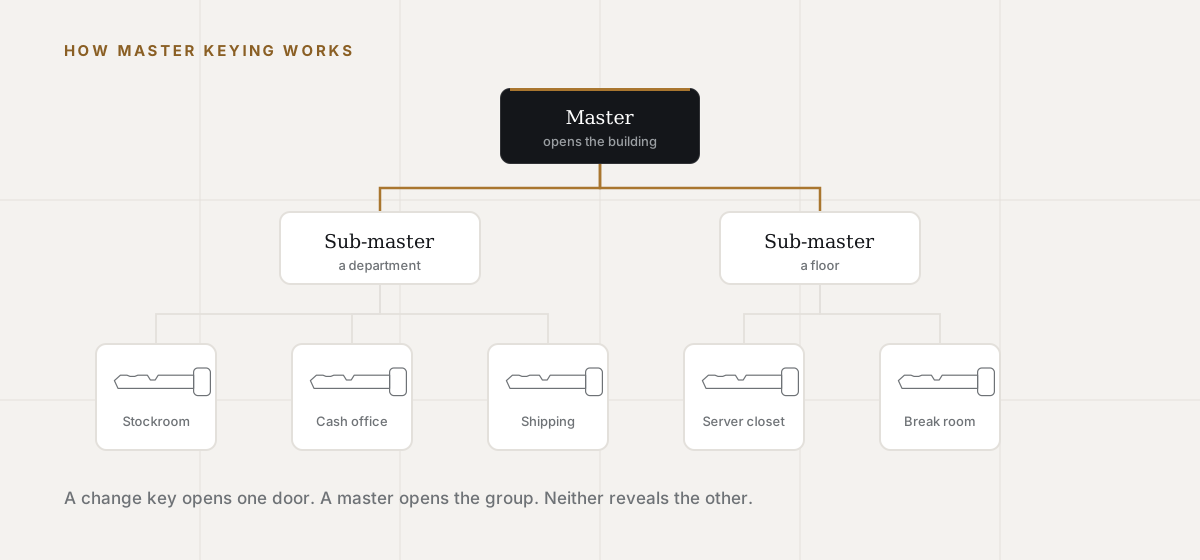
Normally one key operates one lock. In a master key system, each lock accepts two or more different keys: a change key that opens only that door, and a master key that opens a whole group of doors.
So a shift lead carries one key that opens the stockroom. The store manager carries one key that opens every door in the building. Neither key can be used to figure out the other.
The levels, in order
- Change key — one door. The key you hand to the person who needs that one room.
- Sub-master — a group. All the doors in shipping, or every unit on the second floor.
- Master — the building.
- Grand master — multiple buildings. Relevant if you have three locations or a property portfolio.
Most Tulsa businesses we key need two levels. Multi-tenant buildings and property managers often need three.
When you actually need one
You need master keying when the answer to “who can open this door?” is different for different doors. Concretely:
- You have staff who should reach some rooms but not others — cash office, server closet, chemical storage, personnel files.
- You have more than about eight doors and people are carrying key rings.
- You are a property manager who needs access to units without holding a separate key for each.
- You have contractors or cleaners who need one specific area after hours.
You do not need it for a four-door shop where everyone has the same access. Keying all the locks alike is simpler, cheaper and easier to maintain.
The three mistakes that kill a system
1. No written keying schedule
A master key system is a mathematical structure. Every cylinder has to be pinned to work with its change key and its master, and those combinations have to be tracked. If nobody documented the schedule, the next locksmith is reverse-engineering your building — and the honest ones will tell you a survey has to come first.
We keep the schedule and give you a copy. It should live with your insurance paperwork, not in a truck.
2. Building it with no room to grow
A system designed to exactly fit today’s twelve doors runs out of usable combinations the moment you add a suite, split a department or take on a second building. A properly designed system reserves expansion capacity from the start. This costs nothing extra at design time and a full rekey to fix later.
3. Using a keyway anyone can copy
This is the one that undoes everything. You can build a beautiful three-level system and hand a manager a master key — and if it is a standard keyway, that manager can have five copies cut at a hardware store on their lunch break, no questions asked. A master key that circulates freely is worse than no master key, because you believe you have control that you do not.
Restricted keyways solve this. The blanks are not sold on the open market, so copies come only from the locksmith who holds your system — against your written authorisation. If you are putting in a master key system, this is the part not to skip.
What the process looks like
- Walk the building. Every door, every existing cylinder, every hardware brand. We note what can be reused.
- Define the groups. Not doors — people. Who needs what. This is a business conversation, not a hardware one, and it is where the real design happens.
- Design the schedule, with expansion built in.
- Pin and install, usually outside business hours.
- Hand over keys and the record, with keys stamped so a found key can be traced back to its level without saying so on the key.
Keeping it alive
A system is only as good as its record-keeping. Log who receives which key and when. Collect keys at exit interviews. Call us before you add a door, not after somebody put a hardware-store lock on it — that one lock is now outside your system, and the manager’s master will not open it.
We keep customer-specific inventory for accounts we key, which means your cylinders and blanks are on our shelf. Adding a door next spring does not become a six-week special order.