
This is the question we answer more than any other, usually after somebody has already been quoted a number that made them wince. So here is the honest version, without the sales angle.
What rekeying actually is
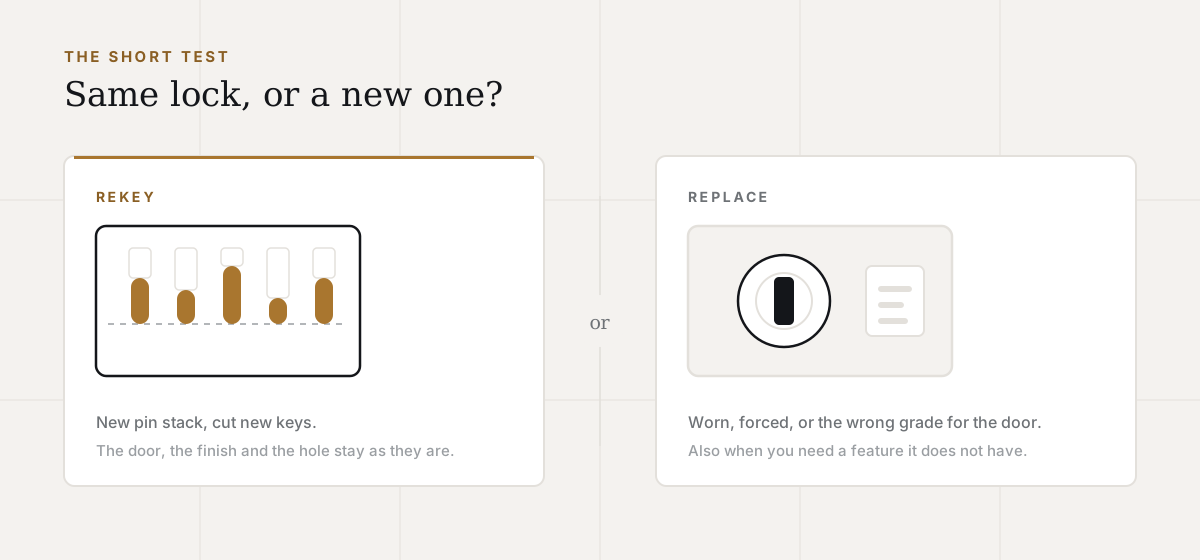
Inside most lock cylinders is a stack of small brass pins. The cut of your key lifts those pins to a specific height, and when every pin lines up, the lock turns. Rekeying means replacing that pin stack with a different combination and cutting new keys to match. The lock stays on the door. The finish, the handle, the strike, the hole in the door — all of it stays exactly as it is.
What changes is that every key made for the old combination stops working. Permanently.
When rekeying is the right call
- You just bought the house. The previous owner, their agent, the cleaners, a contractor, a neighbour watching the dog — you have no idea how many keys are out there, and neither do they.
- An employee left. Especially one who held a building key. Even amicable departures leave keys unaccounted for.
- You lost a key. Not misplaced-in-the-couch lost. Actually gone, possibly with something identifying attached to it.
- You want fewer keys. Three exterior doors on three different keys can usually become three doors on one key with no new hardware at all.
- A tenant moved out. Standard turnover work, and cheap enough that there is no excuse to skip it.
When you genuinely need new hardware
Rekeying assumes the lock is mechanically sound. It is not the answer when:
- The lock is worn out. If the key has to be jiggled, lifted or persuaded, the wear is in the cylinder and new pins will not fix the feel.
- It was forced. After a break-in or a forced entry, the cylinder, strike and sometimes the frame have taken damage that a rekey does not touch.
- It is builder-grade on a commercial door. Residential-grade hardware on a door that gets used two hundred times a day will keep failing no matter how well it is keyed.
- You need a feature it does not have. A keypad, a restricted keyway, a master key system, ADA-compliant lever hardware — those require the right hardware, not just the right pins.
- The keyway is obsolete. Occasionally we open a lock and find a keyway nobody has stocked blanks for in thirty years. That one gets replaced.
The short test: if the lock works properly and you only need different keys, rekey it. If the lock does not work properly, or you need it to do something new, replace it.
Why you get quoted replacement anyway
Two reasons, and only one of them is dishonest.
The honest reason: replacing hardware is faster and requires less skill than rekeying it. A shop that is busy, or a technician who does not carry a pinning kit, would rather sell you a new lock than sit at your door with tweezers.
The other reason is margin. There is more of it in a box of new locks than in twenty minutes of labour.
We do it the other way round: repair and rekey where the hardware allows, replace where it does not, and tell you which one you are getting before we start.
What it looks like on a commercial building
On a building with a master key system, rekeying is not one decision — it is a plan. Every cylinder has to work with the right change key and the right master, so pulling one cylinder and guessing is how systems get quietly broken. We rekey to a written keying schedule, and you keep a copy. When the next staff change happens, nobody has to reverse-engineer what the last locksmith did.
That document is worth more than the visit. Buildings we have kept records on for fifteen years can be rekeyed in an afternoon. Buildings without records need a survey first.
What to have ready when you call
- How many doors, and how many locks per door (a deadbolt and a knob are two cylinders).
- Whether you want them all on one key.
- Whether the building is master keyed.
- Roughly how old the hardware is, and the brand if you can see it.
With that we can quote it on the phone. Most residential rekeys are a single short visit; most commercial rekeys are scheduled around your hours so nothing happens during business.